
EXCLUSIVE: Is a Nationwide Racketeering Conspiracy Fueling ICE Protests?
Across the United States, protests targeting Immigration and Customs Enforcement (ICE) operations have surged, with coordinated demonstrations erupting in cities like Los Angeles.

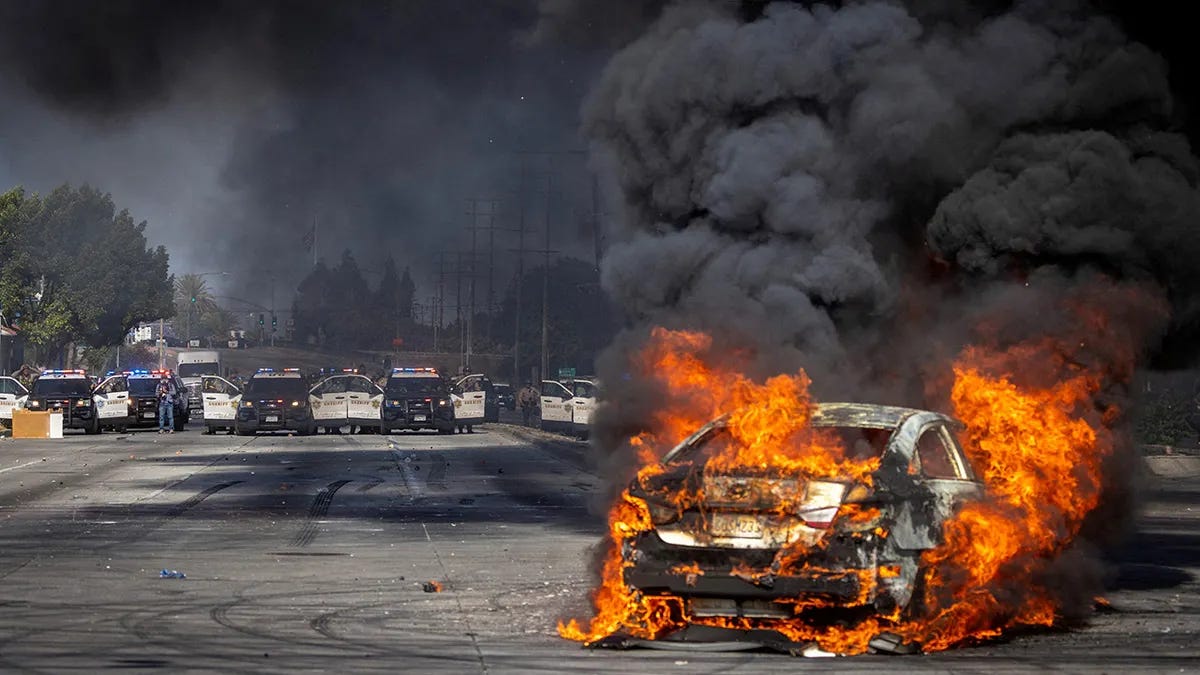
Across the United States, protests targeting Immigration and Customs Enforcement (ICE) operations have surged, with coordinated demonstrations erupting in cities like Los Angeles, Santa Ana, and beyond. These protests, often mobilized rapidly through digital platforms, have raised questions about their organization and intent. At the center of this mobilization is the Action Network, an open platform used by various progressive organizations to coordinate campaigns, share resources, and rally supporters. Groups such as the Daily Kos Liberation League, the Catholic Legal Immigration Network (CLINIC), the National Partnership for New Americans (NPNA), the Service Employees International Union (SEIU), and the Council on American-Islamic Relationsm (CAIR) leverage Action Network to drive their advoccy, including efforts to disrupt ICE activities. With reports of shared toolkits, real-time mapping of ICE raids, and rapid-response training sessions, some are asking: Are these protests isolated acts of civil resistance, or do they represent a coordinated, interstate racketeering conspiracy aimed at undermining the Trump administration? This article explores the evidence and questions whether the FBI and Department of Justice (DOJ) should investigate Action Network and its users under the Racketeer Influenced and Corrupt Organizations Act (RICO).
The Role of Action Network in Mobilizing Protests
Action Network is a digital platform designed to empower grassroots organizing for progressive causes. It provides tools like event mapping, email campaigns, and petition platforms, enabling groups to coordinate actions efficiently. According to its website, Action Network does not control or endorse the actions of its users, positioning itself as a neutral facilitator. However, critics argue that its features—such as Mapbox-powered maps for tracking ICE raids and SimpleMaps for real-time location-based mobilization—enable a level of coordination that suggests more than decentralized activism.
Local groups use Action Network to form rapid-response networks, often through text messages and emails, to mobilize protesters when ICE raids are reported. Individuals joining these groups provide personal information, including their zip codes, to connect with nearby organizers. Toolkits shared across organizations provide strategies for disrupting ICE operations, including how to legally observe raids, warn communities, and challenge local law enforcement collaboration with ICE. This interconnected system raises questions about whether these efforts constitute a loosely organized enterprise under RICO, which defines such an enterprise as any group of individuals associated for a common purpose, even without formal structure.
Organizations Using Action Network
Several prominent organizations, put not limited to, utilize Action Network to advance their advocacy, particularly around immigration and ICE-related issues. Below is an overview of their activities based on available information:
Daily Kos Liberation League The Daily Kos Liberation League, a progressive group focused on racial justice, uses Action Network to publish blogs and campaigns that challenge systemic inequities. In a recent campaign, the League joined allies at Cosecha to demand that U.S. mayors warn immigrant communities of ICE raids, end police-ICE collaboration, and ban ICE from public spaces. A document on their website critiques the deployment of the National Guard, framing it as a “fascist movement” that will galvanize civil resistance, particularly among Mexican Americans. The document suggests that such resistance could counter a “virtual-reality-driven right-wing movement,” hinting at a broader ideological battle.
Catholic Legal Immigration Network (CLINIC) CLINIC, guided by Catholic principles and supported by church funding, focuses on advocacy, legal services, and education for immigrants. Post-election, CLINIC released a toolkit for immigrants, emphasizing direct representation for asylum seekers, family reunification, and increased legal support for those in detention. By using Action Network to distribute these resources, CLINIC amplifies its reach, encouraging local groups to educate communities about their rights and resist ICE enforcement. Their work, while rooted in humanitarian goals, contributes to the broader network of anti-ICE activism.
National Partnership for New Americans (NPNA) NPNA promotes immigrant integration through programs like Cities and Counties for Citizenship and the Legal Services Collaborative. Using Action Network, NPNA organizes campaigns such as We Are All America and Fairness to Freedom, which advocate for refugee and asylum seeker rights. An upcoming conference on June 13, 2025, co-hosted with groups like the Interfaith Immigration Coalition, will feature speakers from refugee communities and faith-based organizations, aiming to “restore welcome for all.” These efforts align with broader protest movements by equipping advocates with tools to challenge immigration enforcement.
Council on American-Islamic Relations (CAIR) CAIR, a Muslim civil rights organization, uses Action Network to coordinate advocacy and rapid-response initiatives. On June 9, 2025, CAIR’s Greater Los Angeles chapter, in collaboration with the OC Rapid Response Network (OCRRN), will host an emergency training session in Anaheim. The session, prompted by daily ICE raids at the Santa Ana Immigration Courthouse, will train first responders on handling ICE sightings, understanding detainment protocols, and navigating legal observation in public versus private spaces. CAIR’s involvement underscores the intersection of immigration and civil rights activism, amplifying calls for resistance to ICE operations.
Service Employees International Union (SEIU) The SEIU, representing 2.1 million members, is dedicated to improving the lives of workers and creating a more just society. In a recent incident, SEIU California President David Huerta was injured and detained while documenting an ICE raid in downtown Los Angeles on June 6, 2025. Huerta, 58, was treated at a hospital before being transferred to the Metropolitan Detention Center, where he remained in custody, according to union officials. The incident sparked protests outside the detention center, with demonstrators spray-painting messages such as “F— ICE,” “Burn Prisons,” and “Abolish ICE.” SEIU’s use of Action Network to mobilize supporters and coordinate responses to such incidents highlights its role in the broader anti-ICE movement, amplifying calls for worker and immigrant rights.
The Protests and Their Coordination
Street protests against ICE have become a visible expression of resistance, with rapid mobilization enabled by Action Network’s tools. In Los Angeles, protests have coincided with reported ICE activities, such as the detention of SEIU’s David Huerta, drawing crowds organized through text alerts and email campaigns. The OCRRN’s training session in Anaheim, scheduled for June 9, 2025, is a direct response to local raids, suggesting a reactive yet highly organized effort. Similar protests have emerged in other states, with groups sharing strategies to disrupt ICE operations, warn communities, and pressure local governments to limit cooperation with federal immigration authorities.
The use of shared toolkits and real-time mapping tools indicates a level of coordination that transcends local activism. For instance, Action Network’s mapping features allow groups to pinpoint ICE activities and mobilize protesters quickly, creating the appearance of spontaneous uprisings. However, the systematic sharing of resources and training materials across state lines—evidenced by groups like SEIU, CAIR, and NPNA using similar platforms and strategies—suggests a more structured effort, potentially meeting the RICO definition of an ongoing scheme to advance a common purpose.
Is This a RICO Conspiracy?
Under the RICO Act, a conspiracy involves an agreement to commit racketeering activities through a criminal enterprise, which can include loosely organized groups. Racketeering activities encompass crimes such as extortion, obstruction of justice, or interference with federal law enforcement. To establish a RICO conspiracy, prosecutors must prove an ongoing pattern of criminal acts tied to the enterprise’s goals, often spanning state lines.
The Trump Administration Context
The timing of these protests coincides with heightened immigration enforcement under the Trump administration, which has prioritized deportations and border security. Organizations using Action Network frame their resistance as a moral imperative, citing policies they view as inhumane or discriminatory. For example, CLINIC’s toolkit, CAIR’s training sessions, and SEIU’s response to Huerta’s detention reflect efforts to protect vulnerable communities. However, critics contend that these actions are strategically designed to destabilize the administration’s agenda, leveraging coordinated protests to create political pressure and public unrest.
A Call for Investigation?
The coordinated use of Action Network by groups like the Daily Kos Liberation League, CLINIC, NPNA, CAIR, and SEIU to mobilize anti-ICE protests raises serious questions about the nature of their activities. The platform’s tools enable rapid, interstate coordination, creating a network that appears more organized than decentralized. Shared toolkits, real-time mapping, training sessions, and high-profile protests—like those following SEIU President David Huerta’s detention—suggest a pattern of behavior that could, in theory, meet the criteria for a RICO conspiracy if tied to criminal acts like obstruction of federal law enforcement.
Inferring a racketeering conspiracy to undermine the Trump administration requires further investigation. The FBI and DOJ should examine whether these groups’ actions cross the line from protected advocacy to criminal coordination. Key questions include: Are specific leaders orchestrating these protests with intent to violate federal law? Do shared resources, training materials, or protest actions like the SEIU-led vandalism explicitly encourage illegal acts? Without such evidence, the conspiracy remains a hypothesis, albeit one fueled by the scale, synchronization, and intensity of the protests.
As immigration enforcement intensifies, the line between civil resistance and coordinated disruption will remain contentious. The public deserves clarity on whether these protests are grassroots expressions of dissent or a calculated effort to destabilize the administration. Until then, the call for an FBI and DOJ investigation into Action Network and its users, including prominent organizations like SEIU, will continue to resonate among those who see a deeper agenda at play.
Excellent. Yes, this is a real insurrection organized exactly like a criminal conspiracy. The democrats and their allies have violently invaded America. Now it is time for them to experience the FO part of FAFO.