

“If we are not prepared to defend a tolerant society against the onslaught of the intolerant, then the tolerant will be destroyed, and tolerance with them,” Karl Popper.
Robert Conquest’s Second Law states that any organization not explicitly and constitutionally right-wing will sooner or later become left-wing. This pairs with Nassim Nicholas Taleb’s dictatorship of the small minority, sometimes called the rule of the intolerant minority or Law of Intolerant Factions, which explains how a committed intolerant minority can dictate the behavior of a larger tolerant group.
Erica Chenoweth and Maria J. Stephan’s 3.5 percent rule further shows that no government or large institution can withstand a challenge once at least 3.5 percent of the relevant population actively and nonviolently mobilizes against the status quo. Mark Lichbach’s earlier work in The Rebel’s Dilemma similarly identified a cohesive 5 percent threshold capable of overwhelming a state apparatus.
Together these analyses demonstrate that the most committed and uncompromising faction, when tolerated, eventually takes over and redefines the entire organization and institutes purity tests that weed out the establishment centrist party.
Robert Conquest’s Three Laws are as follows. First Law: Everyone is conservative about what he knows best. Second Law: Any organization not explicitly and constitutionally right-wing will sooner or later become left-wing. Third Law: The behavior of any bureaucratic organization can best be understood by assuming that it is controlled by a secret cabal of its enemies. This accurately describes the unsubstantiated AIPAC conspiracy defining them as the secret cabal behind the curtain. The wizard behind the curtain in The Wizard of Oz symbolizes false authority, political deception, and the illusion of power that the DSA faction assigns to AIPAC, Israel, the Jewish American coalition, American Christian Zionists within the establishment Democrat Party and the broader majority of society as a whole.
Robert Conquest, whose full name was George Robert Acworth Conquest, was a British-American historian and poet renowned for his rigorous documentation of Soviet totalitarianism. He is best known for works such as The Great Terror that exposed the scale of Stalin’s purges and the realities of communist rule.
Conquest shared these observations informally in conversation, essays, and lectures during the 1970s and 1980s. Reflections on a Ravaged Century from 1999 and 2000 marks the first formal book-length presentation of his broader analysis of ideological capture and institutional decay.
Active protection is essential. Only strict foundational rules that explicitly stop the insurgence can keep an organization from abandoning its original purpose. These include hard constitutional barriers, sacred mission statements, rigorous membership and expulsion criteria, or equivalent structural defenses.
Passive openness, big tent tolerance, or reliance on undefined cultural norms fails. The most committed and intolerant faction invests more energy, accepts fewer compromises, and systematically captures leadership, language, and direction. Rigid guardrails must be erected to protect the institution from a parasitic malignant virulent evil from overpowering the Party.
Cultural shift insurgences illustrate the pattern repeatedly. The law is commonly invoked to explain leftward drift in mainstream charities, churches, professional associations, universities, medical bodies, and NGOs. Conquest himself pointed to the Church of England and Amnesty International as classic cases. Once they lacked explicit enforceable safeguards for their founding orientation, radical elements redefined them.
Lenin’s practice serves as the historical reference. Lenin never named a formal law of intolerant factions, yet his career embodied it. In What Is to Be Done from 1902 he insisted on a disciplined vanguard of professional revolutionaries rather than a broad tolerant workers’ party.
Moderates such as the Mensheviks and reformists were treated as opportunists who diluted the revolutionary line. The 1903 Bolshevik Menshevik split turned on precisely this asymmetry of commitment and intolerance. Once in power, the Tenth Party Congress in 1921 under Lenin formally banned organized factions inside the Communist Party.
Groups with platforms were ordered dissolved, and violations could mean expulsion even of Central Committee members. The official party of Vladimir Lenin after rival factions were pushed out and banned was the Russian Communist Party Bolsheviks, which later evolved into the All Union Communist Party and the Communist Party of the Soviet Union. Party name evolution began with the Russian Social Democratic Labour Party Bolsheviks as the original umbrella party where Lenin’s radical wing operated as a distinct faction starting in 1903.
It became the Russian Communist Party Bolsheviks in 1918 after seizing state power, reflecting a complete break from reformists and rival groups. It later adopted the name Communist Party of the Soviet Union following the consolidation of the Soviet state.
Primary sources include the Marxists Internet Archive hosting Lenin’s Collected Works and the verbatim text of the Tenth Party Congress resolution On Party Unity. The Workers Opposition documents via Historical Materialism provide the perspective of factions Lenin dissolved. Encyclopaedia Britannica covers the Bolshevik Menshevik split. Seventeen Moments in Soviet History from Michigan State University details the 1921 Congress. Academic works include Congress of Contradictions The Tenth Party Congress March 1921 from Brill and Orlando Figes historical archive.
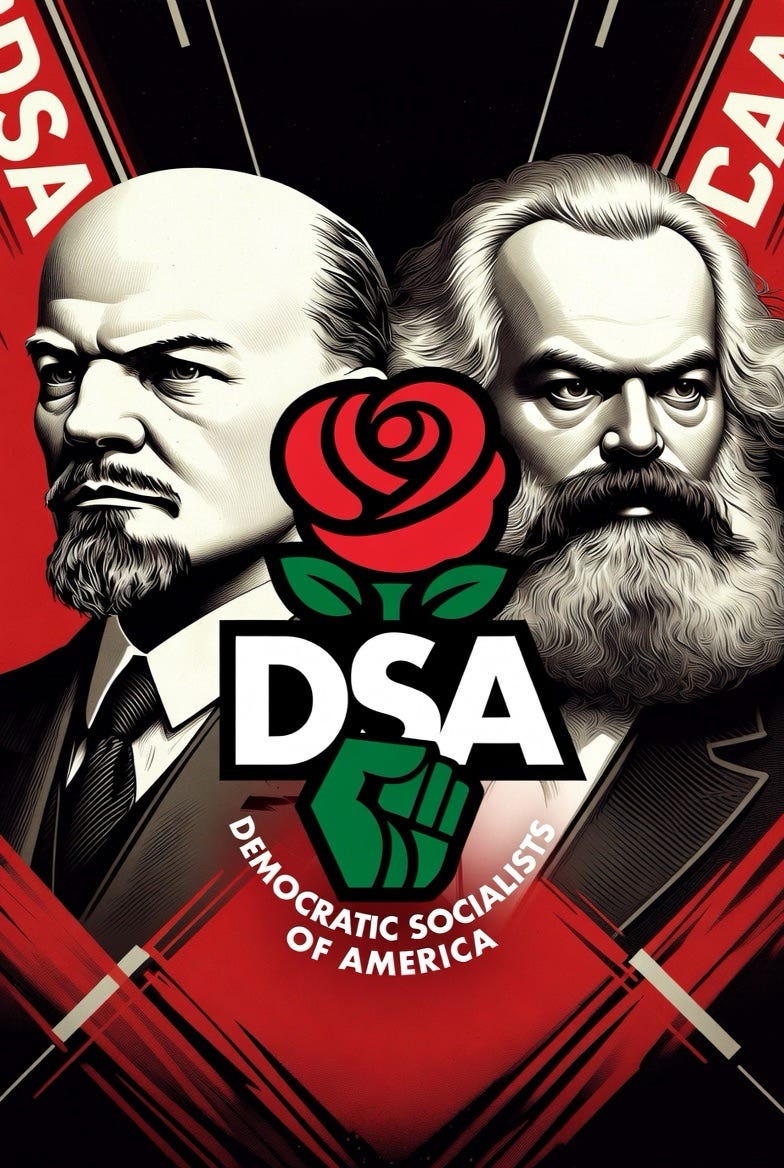
The insurgence of the DSA and inability of the Democrat Party to establish concrete exclusion rules follows the same pattern of minority capture described by Conquest, Taleb, Chenoweth, Stephan, and Lichbach. After the 2016 Bernie Sanders surge it adopted a big tent posture that attracted and empowered far more radical elements.
Explicit communist and Marxist Leninist caucuses including Red Star, Marxist Unity Group, and Emerge now hold significant or majority influence on the National Political Committee. Democratic centralist restrictions were repealed. Platforms hardened toward revolutionary demands such as abolishing the Senate, subordinating the presidency and judiciary, and abolishing the carceral forces of the capitalist state. These caucuses treat DSA itself as contested terrain for disciplined cadre work and political education drawn from Lenin. More moderate socialists inside the organization have been outvoted or sidelined.
This is the classic intolerant faction dynamic operating without sufficient foundational barriers. The purity tests applied by the DSA for their criteria of candidates require demonstration of intolerance for any entity attached or adjacent to American Jewish constituents or for policies that reinforce the strong American Israel relationship that has consistently forged a partnership with action to preserve western civilization ideals.
A highly committed vocal minority within the broader Democratic electorate, well below the 3.5 percent national threshold yet concentrated and active in key primaries and activist networks, has proven sufficient to shift party platforms, candidate selection, and institutional culture in the same way historical movements reached critical mass to force systemic change.
DSA’s strategy toward the Democratic Party is a form of entryism sometimes called the dirty break. The political strategy known as the dirty break was coined by writer and activist Eric Blanc in late 2017. He introduced the term in a Jacobin article discussing electoral approaches for socialists. Candidates run on the Democratic ballot line especially in low turnout safe blue primaries to gain office and infrastructure while building an independent socialist vehicle that ultimately aims to realign or replace the party. DSA leaders have stated they do not share the Democratic establishment’s goals and treat the party primarily as a ballot access tool.
In the 2026 primaries DSA candidates produced visible results as they defeated establishment incumbents in deep blue districts. Centrists described the process as parasitic or a hostile takeover. The same asymmetry that let Bolsheviks capture Russian social democracy now lets the most radical DSA factions shift Democratic primaries, platforms, activist energy, and branding leftward while the original moderate base is hollowed out.
Without strict enforceable foundational rules that actively protect the original mission, the pattern repeats. Tolerance invites capture. Cultural and personnel drift accelerates. The intolerant faction defines the whole.
Historical parallels such as British Labour’s experience with Militant Tendency and earlier United States socialist splits show that push back is possible but costly once the process is advanced. Successful historical applications of the 3.5 percent threshold include the People Power Movement that overthrew Ferdinand Marcos in the Philippines in 1986, the Velvet Revolution that toppled the communist government in Czechoslovakia in 1989, and the Singing Revolution that enabled Estonia to break from the Soviet Union in the late 1980s.
The solution for the Democrat Party draws from the historical account of the McGovern rise and fall. Democrat George McGovern’s 1972 presidential campaign represented a sharp leftward capture that produced a landslide defeat. Democrat leadership then pursued a deliberate strategy of shifting back to a centrist position. This recovery restored electability and broader appeal.
A healthy two party system with constructive opposition is the framework that kept a productive balance within society to maintain the desired checks and balances of modern day America. By reasserting concrete exclusion rules against the most intolerant elements and recentering the party, Democrats can prevent further capture while preserving competitive opposition that strengthens the overall constitutional order.
“Those who would give up essential Liberty, to purchase a little temporary Safety, deserve neither Liberty nor Safety," Benjamin Franklin.
… The End …
Footnotes:
(1) Nassim Nicholas Taleb’s dictatorship of the small minority is discussed in Skin in the Game and at
https://www.shortform.com/blog/the-3-5-rule/.
(2) Erica Chenoweth and Maria J. Stephan’s 3.5 percent rule and analysis appear in Why Civil Resistance Works at https://a.co/d/0j20pE3C and https://www.americanbar.org/groups/crsj/resources/human-rights/2025-october/defeating-tyranny/.
(3) John Derbyshire summarizes Conquest’s Laws in National Review at https://www.nationalreview.com/corner/conquests-laws-john-derbyshire/.
(4) Robert Conquest’s Reflections on a Ravaged Century was published by W.W. Norton in 1999, 2000, and 2001.
(5) Lenin’s Tenth Party Congress materials including On Party Unity are at https://www.marxists.org/archive/lenin/works/1921/10thcong/index.htm andhttps://soviethistory.msu.edu/1921/tenth-party-congress/.
(6) Additional analysis of the Tenth Party Congress is at
(7) Reporting on DSA communist caucuses and National Political Committee composition appears in City Journal under Actually a Lot of DSA Members Are Communists, in The Free Press under The DSA’s Communist Turn, and in The Atlantic under The DSA Is a Parasite.
Related discussion by James Lindsay on his New Discourses channel titled “What Is the DSA Platform” on YouTube. You can also find him on X.
